Writing
Myths, filed as news
“Myth is neither poem nor science nor philosophy, although it coincides with the first in its procedures (poetic function), with the second by its logic and with the last by its aim of offering us an idea of the universe.”
– Octavio Paz, Claude Lévi-Strauss: An Introduction
Since 1988, the tourism bureau of the Atsumi Peninsula has dropped marked coconuts into the sea near Ishigaki, about 1,600 kilometres to the south, to see whether the current will carry one to Koijigahama, where the coconut in a Shimazaki Tōson poem is said to have washed ashore. As of 2020, none had arrived.
Every piece of ground runs on stories like this. A few are told at festivals. Most are written into budgets, zoning maps, tourism campaigns, flood plans, and press releases, where nobody thinks to call them myth. They are myth nonetheless: the accounts a place lives by of where it came from, what it owes, what it fears, and what it is waiting for.
Each piece at Made Ground starts somewhere real and then records what is there in the plain voice of the gazetteer: the water, the industries, the wars, the festivals, the people who left and the things that arrived. Then, somewhere in the record, it sets down something that is not there. The invention isn’t marked. It sits alongside the population figures and the dates of founding, and it is held to the same standard: it has to be true of the place, even if it never happened to it.
In 713, the Japanese court ordered every province to send in an account of itself: what it produced, how good its soil was, where its place names came from, and the old stories its people told. The fudoki (風土記) that survive set the yield of a field beside the god who named the hill, and nobody saw a reason to keep them apart.
Schelling argued that myths can’t be invented. Poets don’t make them; peoples live through them. He was right. The invented parts here are not the myth.
Reports are filed as received. Corrections will be printed when the place makes them.
Free to read.
Essays and Criticism
The Japanese Words for Space Could Change Your View of the World — Quartz, 2018. The publication’s most-read piece of that year; more than 50,000 shares. Watsuji Tetsurō’s fūdo applied to contemporary spatial experience.
Centering Aesthetics in Community Development — Research Handbook on Community Development, Edward Elgar, 2020.
Collaborative Creativity and Creative Collaboration as Future Work Paradigms — The Future of Education and Labor, Springer, 2019.
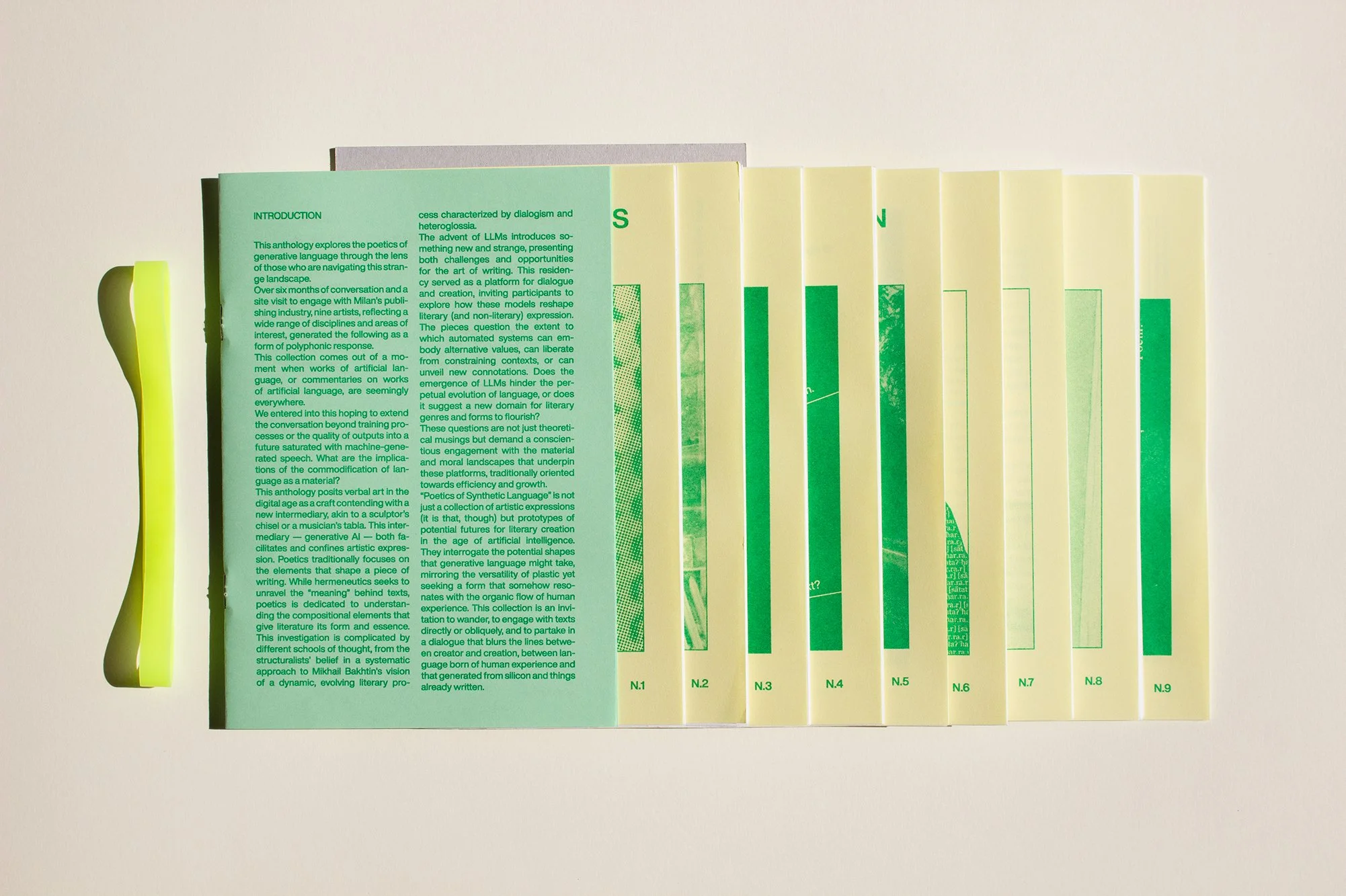
Poetics of Synthetic Language · 2024
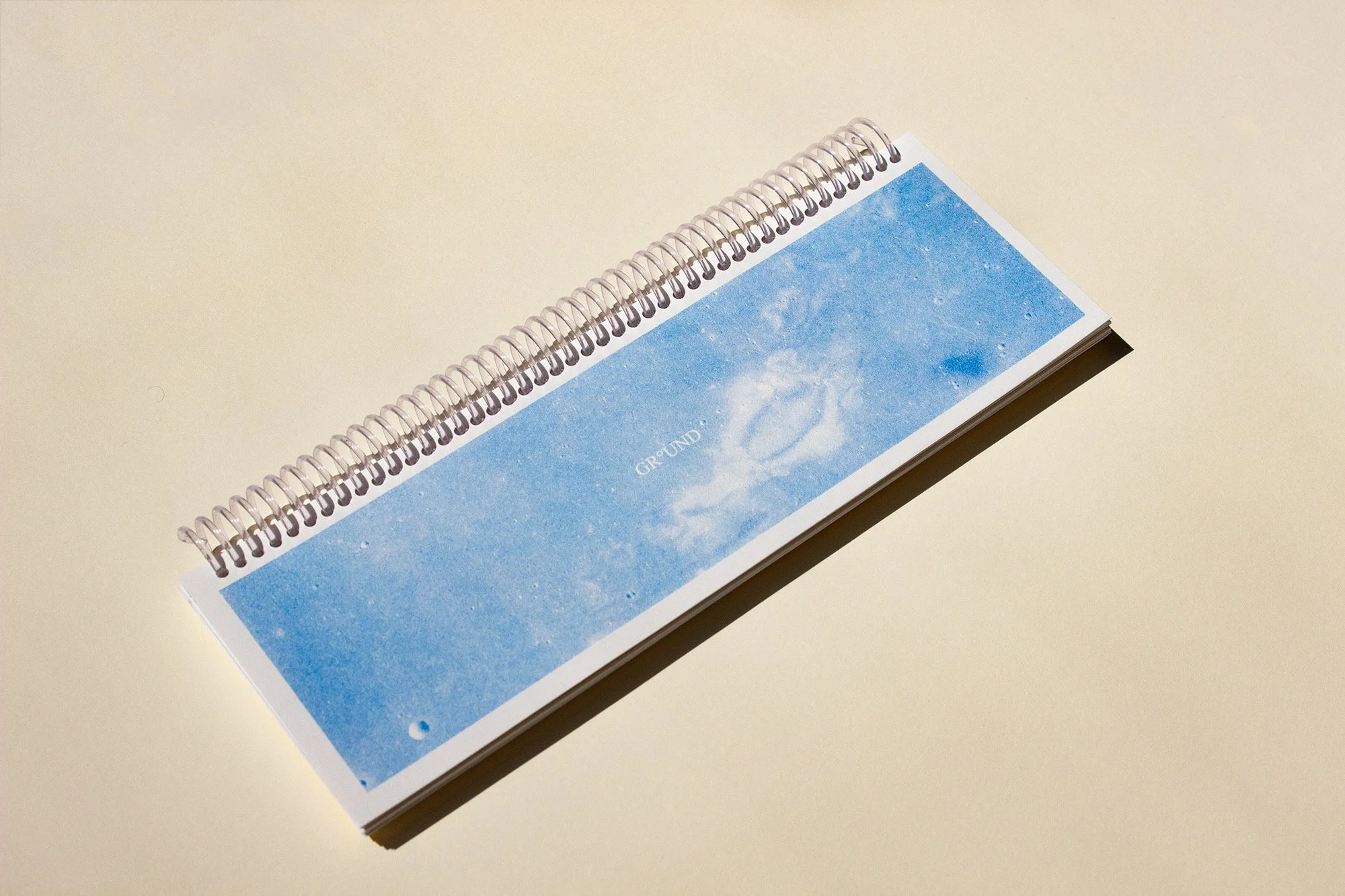
GROUND · 2022
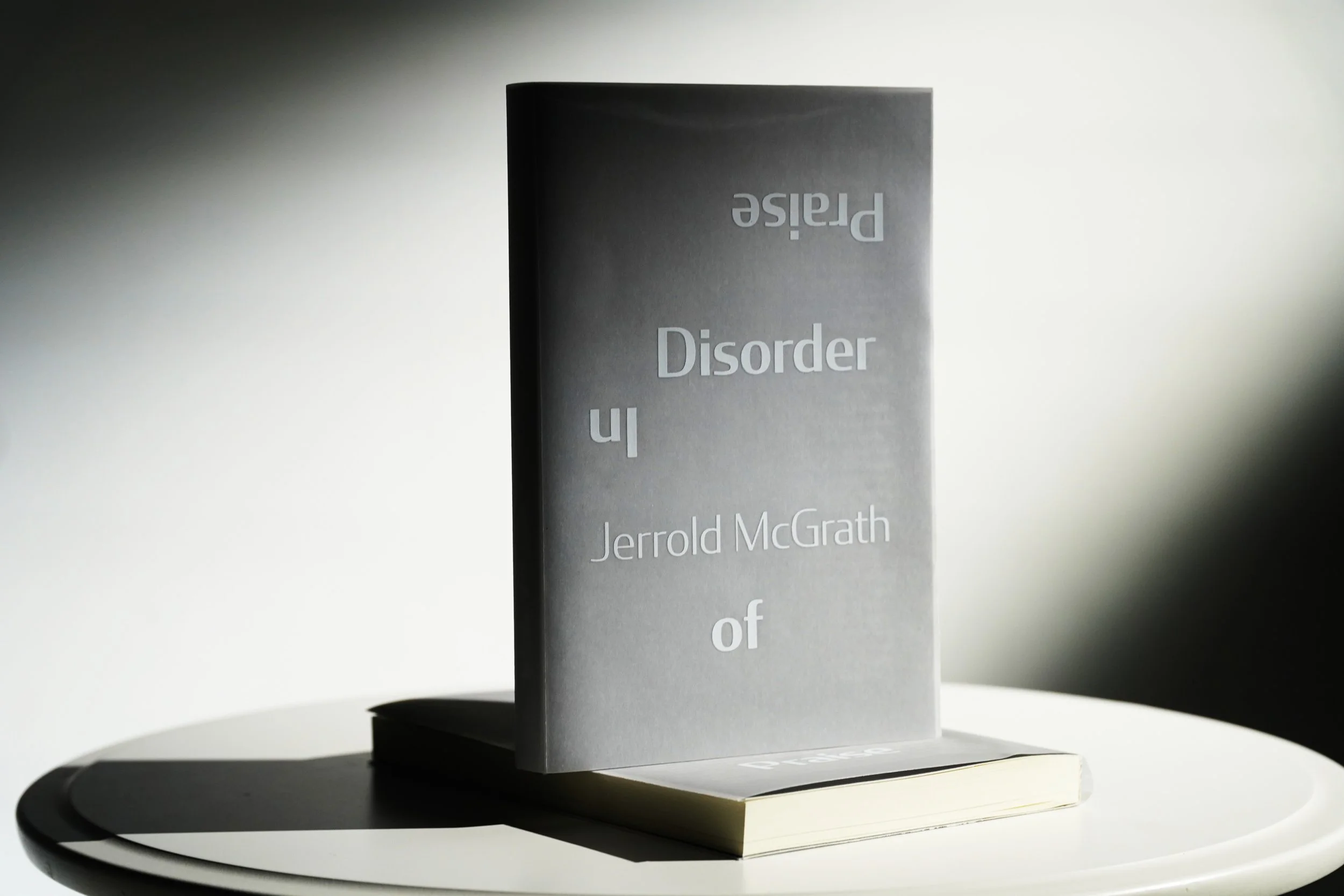
In Praise of Disorder · 2023
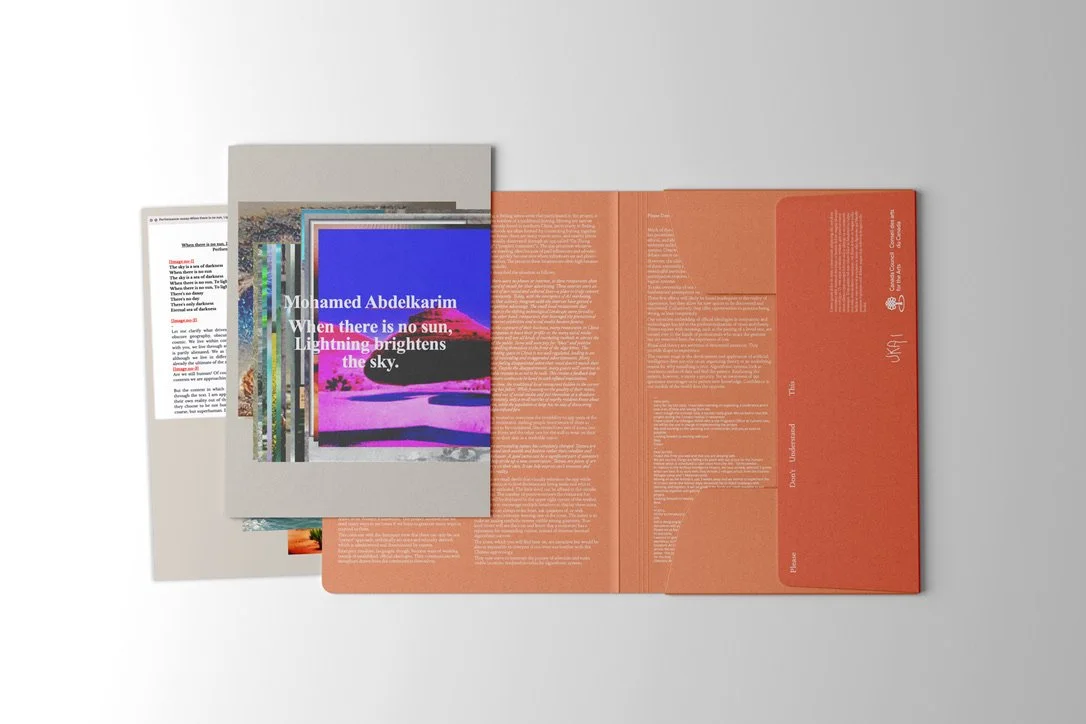
Please Don't Understand This · 2022
Books
In Praise of Disorder — UKAI Projects, 2023. On the generative potential of disorder: not as a problem to be managed but as the condition from which culture and meaning emerge. The first half is how the present order was built and what it costs — choking, ambivalence, Procrustes and his iron bed, dystopia, poaching. The second half is practice: lingering, interrupting, ritualizing and theorizing, beating the bounds. 247 pages. Edited by Richard Martin. ISBN 978-1-7386464-0-1
First edition of 500, signed. CA$45, shipping included in Canada. Order. Also in paperback, ebook and audiobook from Amazon.
Poetics of Synthetic Language — UKAI Projects, 2024. An art book following a nine-month residency with artists and writers working with generative language. Includes a site visit to Milan on the politics and aesthetics of contemporary printing. Designed by Mida Fiore. Printed at Press Press Milano. Riso-printed edition of 100. Work by Jerrold McGrath, Luisa Ji, JC Fung, Darian Razdar, Bianca Weeko-Martin, Leslie Predy, Katie Sullivan, Helen Lam and Gurpreet Surman. Edited and curated by Jerrold McGrath.
CA$70, shipping included in Canada. Order.
Please Don’t Understand This — UKAI Projects, 2022. A decentralized residency and print publication, premised on the observation that nearly every ethical framework for AI extends from Western traditions. Micro-residencies at Dzaleka refugee camp in Malawi, a hutong in Beijing, and an Arabic-speaking design community in Cairo. Designed using only mass-produced stationery appropriate to each region of production. ISBN 978-1-7386464-1-8
GROUND — UKAI Projects, 2022. A tabletop role-playing game and print publication in which players inhabit worlds settled entirely by ideas. Characters cannot improve, only deplete. Play sessions in Toronto, Berlin, Bristol, and Milan.
In Progress
Material Culture Under Authoritarianism — research into how cultural objects are produced, distributed, and received under conditions of political closure: what the relationship between form, distribution, and resistance reveals when the usual channels are surveilled or co-opted. In development as a book and through a record label partnership.
Commissions
Available for essay commissions. hello@jerroldmcgrath.com